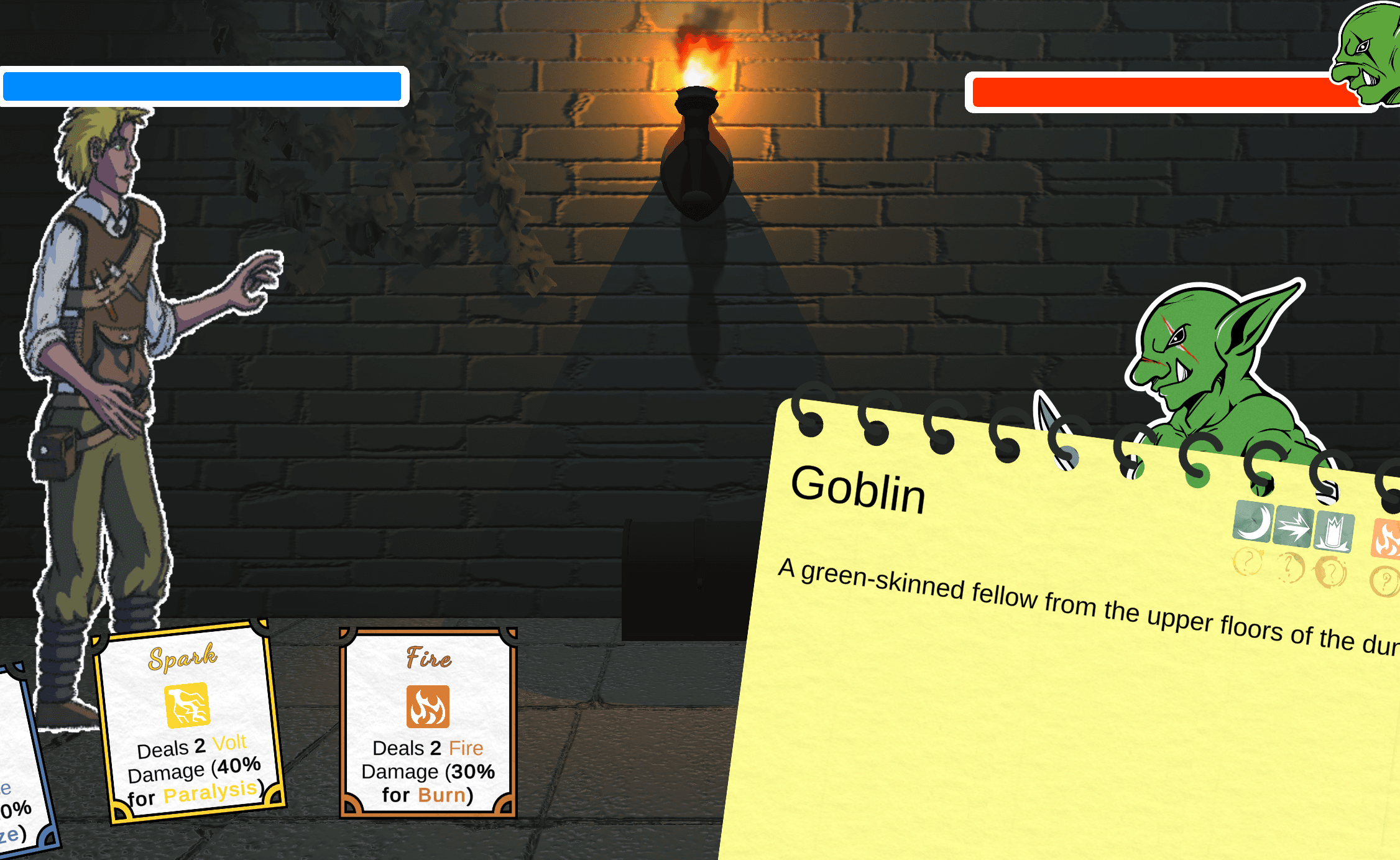
Fight off enemy after enemy by ever-so-carefully combining your attacks, making good use of their elemental shortcomings. Gradually expand your collection of attacks and give them a bit of an upgrade to stand a chance against the more frightfully tough chaps you’ll encounter!
The Alchemist's Handbook marks my fourth foray into the world of game jams, and as always, it all took place in the lovely city of Hanover, hosted at the charming SAE Institute. This time around, my dear friend Theia kindly returned, and I found myself once again in the delightful company of several familiar faces from previous escapades:
Hai Lam, whom you may recall from last year, lent her truly marvellous artistic talents once again, and Luke popped back in to assist with all things Unity, bless him.
We were also fortunate enough to have another rather talented artist aboard, who goes by the delightful moniker of Koa’Rynn - all in all, the visuals were far snazzier than usual, if I may say so.
Our good mate Jonas did intend to provide some musical accompaniment as per usual, but alas, he took an unfortunate tumble and injured his hand on the very first day. Thus, while technically a member of the team, his contribution this time was more... moral than musical, so to speak. As such, the game is regrettably without audio, as we were rather averse to using stock sounds from the internet - seemed a bit gauche, frankly.
Still, in the end, I daresay we managed to cobble together quite the enjoyable little game. The balance might be ever so slightly off - reaching the final stage is a bit of a faff - and I do feel awfully sorry for Hai Lam, whose splendid dragon illustration will, tragically, seldom see the light of day.
Idea
This time, the theme was "Curiosity". A fair few teams went with the whole "curiosity killed the cat" angle (predictable, if you ask me), and at least two opted for something involving the Mars rover - which, I suppose, is clever if a tad on the nose. I, on the other hand, was rather more intrigued by the broader notion of discovery. I’d also long fancied doing something with a jolly good RPG battle system, so we went with a sort of Darkest Dungeon-inspired setup, in which you fight an endless queue of foes using card-based attacks - a bit of strategy, a dash of luck, and a sprinkling of chaos.
There are several rather charming ways the curiosity theme peeks through in The Alchemist’s Handbook:
- There’s the business of deducing the enemies’ weaknesses and scribbling them down in the titular handbook
- Then there’s the thrill of exploring new attack combinations and seeing what they do
- And lastly, the narrative element, with the alchemist exploring deeper and deeper into the dungeon, driven entirely by their own insatiable curiosity. Quite poetic, really.
Combat
Now, I must admit, I’m particularly chuffed with how the combat system turned out - though it’s a touch limited, allowing only one adversary on the screen at any given time. Introducing multiple enemies would’ve meant adding a whole mechanic for choosing whom to wallop, and frankly, I felt that was a step too far for a jam weekend.
The game proceeds through four rather neatly organised stages, each with their own bespoke baddie:
Goblin → Skeleton → Elemental Mage → Elemental Dragon
You’ll need to dispatch each one in turn before moving on - not exactly cricket if you try to skip ahead.
Elemental Attacks
There are six jolly good damage types: three physical (Slash, Stab, and Bash) and three elemental (Fire, Ice, and Electricity - or "Volt", because we’re being fancy). Fans of classic Atlus games like Persona 3 or Etrian Odyssey may find them charmingly familiar - and indeed, they were my inspiration.
Each attack is represented by a corresponding card: Sword for Slash, Lance for Stab, Hammer for Bash, and orbs for the magical malarkey. At the beginning of a session, you’re handed three cards at random - no arguing! - and must make do as you face your first foe. After each victory, you're offered a choice of three new cards. Pick one: if it’s a new type, huzzah, it joins your arsenal! If you already have it, well, it gets a bit beefier. Quite a neat little system, I thought.
You may choose to be something of a generalist, prepared for anything, or a specialist who hammers home one particular strength (risky business if your preferred flavour is ineffective against a foe, mind).
To keep things from becoming dull, we opted for a system where you always play two cards together, opening the door to flashy combo attacks: freeze your opponent with Ice, then bash them while they’re still chilly, and you’ll do a spot more damage than either attack alone. There are six of these delightful combinations to discover, if you’re the curious sort.
We also decided, in a rather last-minute flourish, to add some status effects:
- Fire might singe and lower the enemy’s attack
- Ice could freeze them and make them a bit more brittle
- Finally, Volt may very well cause them to miss their turn entirely
Rather ambitious, perhaps, and yes, a bit buggy - but we meant well!
Accessibility
If there’s one trend I’ve noticed across my previous game jams, it’s a growing desire to make the ruddy things easier to play.
My first game, Flower Defense, was a downloadable Windows .exe and insisted on a controller. Not the most welcoming format - you had to install it, find your controller (if you even had one), and then hope Windows was feeling cooperative. Frankly, none of my mates could be bothered, so the poor game didn’t see much love.
Murder at the Great Exhibition and Daydreamer were web-based (hooray!) but still relied on keyboard controls, meaning no mobile support - a real pity, considering everyone and their nan has a phone these days.
So this time, I resolved to go full mouse-only. That way, you can simply tap the screen on your mobile and off you go. Unity treats a tap as a click, which is rather convenient. Ideal for a game jam where every minute counts and setting up separate control schemes would be a right bother.
Lessons Learned
This game jam proved especially educational - more so than any prior.
One key takeaway was how to implement decorative animations. I set up the basic combat engine on the first night, using an event-driven system: wait for player input, calculate damage, check for victory, let the enemy have a go, check for defeat, and repeat. If you automate it, the whole fight wraps up in a second - frightfully efficient, if not terribly visual.
Day two was all about animations. Here’s where things got hairy: some animations take longer, some are combos, some are just two attacks - and if there’s no combo, it should play each separately, not get confused and show both at once or freeze entirely.
Hai Lam, bless her, introduced me to the wonderful DOTween plugin - a delightful little tool for animating things smoothly. I used it for the UI; meanwhile, Luke worked on the character animations. He took a more hands-on approach, linking animations directly to the cards. This worked - mostly.
The real pickle came with the elemental attacks. These involved launching actual 3D orbs from the player to the enemy. The animations depended on those orbs hitting a collider on the enemy. Should anything go awry - positioning, timing, a missed frame - the orb would float off like a balloon, never registering a hit. The result? Total soft-lock. Game over, not in the fun way.
We lost hours on Saturday and again on Sunday patching these glitches. The lesson? Don’t rush your animation system. I now intend to build a proper asynchronous framework, where each combat step kicks off an animation object that handles its own business and reports back when finished. And in case things still go pear-shaped, a failsafe timer should reset everything after a few seconds, just to keep the game moving. Belt and braces, as they say.
I was also rather gutted that we didn’t spend more time tweaking the difficulty. As it stands, even flawless players struggle to reach the final baddies unless the card draws are kind. That means most players will never see the mage or dragon sprites - which is a dashed shame, given how much time Hai Lam spent on them. Next time, I’ll make the early stages easier so everyone gets to see the whole shebang, then save the real challenge for the final boss. Seems only fair.
Final Thoughts
We may not have nailed the curiosity theme as squarely as we’d hoped, but all things considered, I’m quite pleased with the outcome. The combat system was a joy to implement, and DOTween made the UI rather lovely, if I do say so myself.
This will probably be my last game jam for a bit, so I sincerely hope you enjoy playing it - and thank you ever so much for reading!